Tenant Portal for Property Management: Transparent Rent Collection, Online Invoices and Tenant Ledger Management
Property management is not just about collecting rent. It also involves maintaining accurate tenant accounts, controlling receipts, resolving payment disputes, tracking outstanding balances and ensuring that both tenants and management have reliable financial information.
Yet many property management businesses still rely on traditional registers, spreadsheets, WhatsApp messages and manually prepared receipts.
Consider a common situation: a property manager maintains a register to record rent invoices and receipts, while individual shopkeepers maintain their own registers to track payments and outstanding balances. Both parties have their own records, but there is no connected system to ensure that the information matches.
When a tenant questions an outstanding balance, management may have to search through old registers, receipts and payment records. When a shopkeeper claims to have paid, the property manager must investigate whether the payment was received and recorded correctly. Preparing consolidated reports across multiple shops or buildings becomes another time-consuming task.
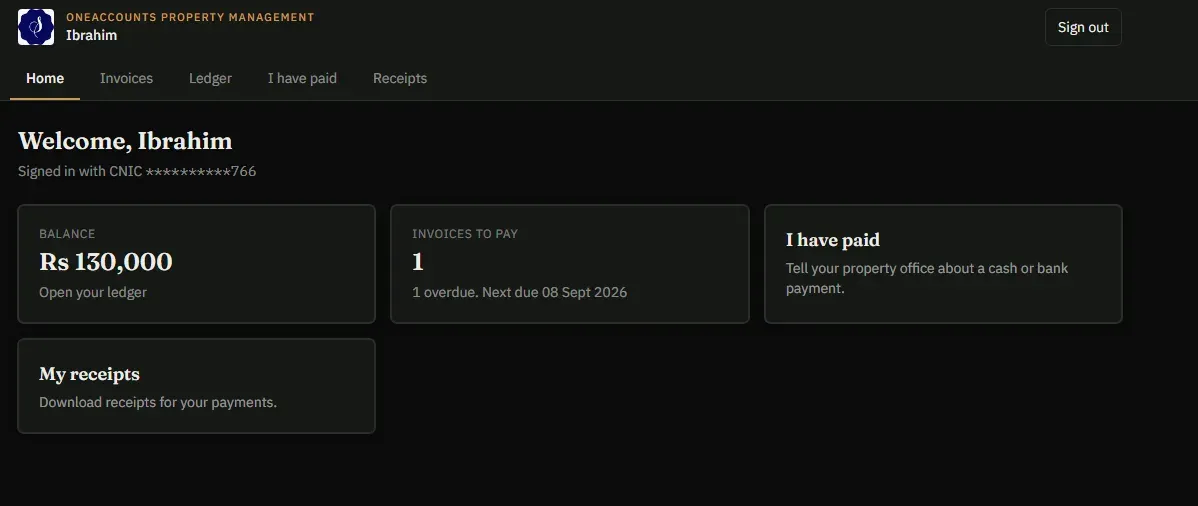
OneAccounts Property Management addresses this challenge through a collaborative tenant portal that connects tenants, invoices, payment communication and accounting records in one controlled workflow.
Instead of relying on separate registers, tenants can access their available invoices and account ledgers, report payments against specific invoices and see their balances updated after the reported payments have been approved and posted in the accounting system.
This approach improves transparency, strengthens receipt control and helps property managers maintain a more organised and reliable accounting process.
1. The Problem With Traditional Property Management Registers
Manual registers have been used for years to manage rental properties, commercial shops, apartment buildings and shopping plazas. They may appear simple, but problems emerge as the number of tenants and transactions increases.
Different records create confusion
When management and tenants maintain separate records, their understanding of an account may differ. A tenant may record a payment that management has not yet verified, or management may have recorded an invoice that the tenant has overlooked.
Without a shared source of account information, resolving these differences requires manual investigation.
Receipt control becomes difficult
Property managers need to know which payments have actually been received, which have been reported by tenants, and which have been recorded in the accounting system.
If these stages are handled through registers and informal messages, it can be difficult to track the status of each transaction consistently.
Reconciliation consumes valuable time
When a tenant disputes a balance, staff may need to compare the tenant's register with management's records, locate previous receipts and check individual entries.
This becomes increasingly difficult when a property has dozens of shops or hundreds of apartments.
Reporting is limited
Management may want to know the total outstanding rent, payments received, tenant-wise balances or the financial position of individual buildings. If the information is scattered across multiple registers, preparing reliable reports requires additional manual work.
Growth increases administrative pressure
Managing five tenants through direct communication may be manageable. Managing hundreds of tenants across several buildings requires a consistent process for invoicing, payment verification, receipt posting and account reconciliation.
The fundamental problem is not the register itself. It is the absence of a connected process that gives tenants visibility while allowing management to maintain control over official accounting records.
2. What Is a Tenant Portal for Property Management?
A tenant portal is an online platform that allows tenants to access relevant rental information and communicate with property management through a central system.
Rather than contacting management every time they need an invoice or account statement, tenants can log in to their portal and review the information available for their accounts.
A collaborative tenant portal goes further than simply displaying information. It connects tenant communication with the property manager's accounting workflow.
With OneAccounts Property Management, tenants can:
- Access their available rent invoices directly through the portal.
- Review their account ledger and outstanding balance.
- Communicate that they have made a payment against a particular invoice.
- Follow the effect of approved and posted transactions on their account.
- Refer to their available account information when discussing a payment or outstanding charge with management.
At the same time, property management retains control over the review and approval of reported payments before the corresponding accounting entries are posted.
The objective is to give tenants greater financial visibility without giving up management's authority over accounting records.
3. Online Rent Invoices: Give Tenants Direct Access to Billing Information
Issuing invoices is a routine but essential part of property management.
When invoices are distributed manually, staff may need to send copies repeatedly, answer questions about billed amounts and locate documents when tenants misplace them.
A tenant portal simplifies this process by making available invoices accessible online.
For example, a shopkeeper in a commercial plaza can log in to review the rent invoice issued for their shop. An apartment tenant can access their available rental billing information without needing to request a separate copy from the property manager.
This creates a more organised billing process and reduces dependence on repetitive manual communication.
Key benefits include:
- Convenient access to rental invoices.
- Better visibility of billed amounts and charges.
- Less time spent responding to routine invoice requests.
- A central place to review available billing information.
- A more structured relationship between invoices and tenant accounts.
For businesses managing multiple buildings, online invoice access can improve the consistency of tenant communication across the property portfolio.
4. Tenant Ledger Management: Make Account Balances Transparent
An invoice shows a charge. A ledger provides a broader view of the account.
Tenants may want to understand their previous balance, current rent, recorded payments and remaining amount payable. Property managers need the same information to answer queries, monitor outstanding rent and maintain reliable records.
A property management software system with a tenant ledger allows tenants to review the available transactions associated with their accounts.
Consider this illustrative example:
| Account transaction | Amount |
|---|---|
| Previous outstanding balance | Rs. 20,000 |
| Current rent invoice | Rs. 75,000 |
| Payment approved and recorded | Rs. 75,000 |
| Remaining outstanding balance | Rs. 20,000 |
In this example, the current invoice has been paid in full, but the previous outstanding balance remains unpaid.
Without a clear ledger, a tenant might assume that paying the current invoice clears the entire account. A ledger makes the relationship between individual transactions and the remaining balance easier to understand.
For property managers, this improves the ability to explain balances using recorded transactions rather than relying on handwritten notes or separate statements.
The result is a more transparent approach to tenant ledger management and fewer avoidable misunderstandings about outstanding rent.
5. Collaborative Payment Reporting: Let Tenants Communicate Payments Against Specific Invoices
One of the most important features of a collaborative tenant portal is the ability for tenants to report payments against particular invoices.
Consider a shopkeeper who transfers rent to the property owner's bank account. The shopkeeper then contacts the property manager to confirm the payment.
In a traditional workflow, management may need to identify the tenant, locate the relevant invoice, check the payment information, communicate with the accounts department and update the ledger.
When many tenants make payments around the same time, these activities can become difficult to coordinate.
OneAccounts Property Management provides a more structured process. Tenants can communicate through their portal that they have paid against a specific invoice.
This connects the payment communication with the relevant tenant account and invoice, helping management review the reported transaction more efficiently.
It also creates a clearer distinction between a tenant's payment notification and an officially recorded receipt.
For example, if a tenant reports paying Rs. 75,000 against a rent invoice, management can review the reported payment and verify the actual receipt of funds before approving the corresponding accounting entry.
This approach helps organise payment communication and supports stronger control over the receipt-posting process.
6. Management Approval: Maintain Control Over Official Accounting Entries
Transparency does not mean allowing unverified transactions to change official financial records.
A tenant may report a payment, but the report alone does not prove that the funds have been received. The property management team must retain control over verification, approval and accounting.
OneAccounts Property Management follows an approval-controlled workflow.
How the process works
Step 1: The invoice is issued
The rent invoice is recorded in the property management system and made available to the tenant through the portal.
Step 2: The tenant reviews the account
The tenant can check available invoices, ledger transactions and the outstanding balance.
Step 3: The tenant reports a payment
The tenant communicates that payment has been made against the relevant invoice.
Step 4: Management reviews the reported payment
The authorised team checks the payment information and verifies receipt of funds through the appropriate process.
Step 5: The payment is approved and posted
After approval, the corresponding accounting entry is posted in the system.
Step 6: The tenant account is updated
The approved transaction appears in the tenant's portal, and the account balance is updated accordingly.
This workflow helps prevent an unapproved payment claim from being treated as a completed accounting transaction.
It also creates a more consistent relationship between tenant communication, management approval and the official accounting records.
For property management businesses, this is an important control over the way payments are processed and tenant balances are maintained.
7. Updated Tenant Balances Through a Connected Accounting Workflow
A tenant portal is most useful when it is connected to the accounting system rather than operating as an isolated communication platform.
If invoices are maintained in one application, payment notifications in WhatsApp and receipts in a separate register, the same transaction may have to be recorded and checked in several places.
This creates unnecessary work and increases the risk of inconsistent information.
OneAccounts Property Management connects the relevant stages through a common workflow:
Invoice Issued → Tenant Ledger → Payment Reported → Management Approval → Accounting Entry Posted → Updated Tenant Balance
When a reported payment is approved and posted, the resulting accounting transaction is reflected in the tenant's account.
This helps tenants review the updated balance and gives management a clearer view of the account position based on recorded transactions.
It also reduces the need for staff to manually update separate records every time an approved payment is processed.
The key benefit is not simply digital recordkeeping. It is the connection between tenant activity and the accounting process.
8. Reduce Tenant Disputes and Repetitive Administrative Work
Property management teams regularly receive questions such as:
- Can you send me my latest rent invoice?
- What is my current outstanding balance?
- Has my payment been recorded?
- Which invoice is still unpaid?
- Why does my account show an outstanding amount?
- Can I review my previous transactions?
These questions are normal in rental businesses, but responding to each one manually can consume a significant amount of time.
A collaborative tenant portal helps tenants access their available account information independently.
When a query arises, both parties have a clearer basis for discussing the account. Management can refer to the recorded transactions and approval process instead of relying entirely on messages, separate registers or handwritten notes.
This can help reduce repetitive communication and make account disputes easier to investigate.
It does not eliminate every dispute or remove the need for personal communication. Billing adjustments, payment differences and exceptional circumstances may still require management attention.
However, a connected system provides a more organised foundation for resolving these issues.
9. Better Reporting and Visibility for Multi-Building Property Management
A property manager responsible for several buildings needs more than individual tenant statements.
Management may need to review outstanding rent, monitor tenant balances, assess the financial performance of individual properties and identify accounts requiring follow-up.
When transactions are maintained in a connected accounting system, the underlying records can support more structured financial reporting.
OneAccounts Property Management brings tenant and accounting workflows together, helping management move away from the fragmented records associated with manual registers.
For businesses managing apartments, commercial shops, offices or shopping plazas, this approach supports a more consistent process across multiple properties.
Instead of relying on individually maintained registers to understand the financial position of a property, management can use the system's available accounting records and reports.
This is especially valuable as the number of tenants, buildings and monthly transactions increases.
10. Why a Collaborative Tenant Portal Is Valuable for Commercial Shops and Apartment Buildings
Different rental properties face different operational challenges, but they share a common requirement: accurate tenant accounts and reliable payment records.
Commercial shops and shopping plazas
Shopkeepers need to understand their rental charges and payments, while property managers need to maintain control over receipts and outstanding balances.
A tenant portal can give shopkeepers access to their available invoices and ledger information while providing management with an approval-controlled payment workflow.
Residential apartments
Apartment tenants frequently need access to rent invoices, account statements and outstanding balances.
A collaborative portal reduces dependence on manually sending account information and provides a more organised channel for payment communication.
Multi-building property portfolios
When a property management business operates several buildings, standardising tenant communication and accounting processes becomes increasingly important.
A connected workflow helps establish consistent procedures for invoice access, payment reporting, approval and account updates across the portfolio.
In each case, the underlying principle is the same: tenants receive greater visibility, while management retains control over official accounting records.
11. OneAccounts Property Management: From Separate Registers to One Collaborative Process
OneAccounts Property Management is designed to connect property operations with financial records and reporting.
Its property management capabilities include property and unit organisation, tenant and owner records, leases, rent invoicing, security deposits, property expenses, owner ledgers and accounting reports.
The collaborative tenant portal extends this approach to tenant financial interactions.
Instead of relying entirely on separate registers and informal messages, tenants can access available invoices, review their ledgers and communicate payments through a structured process.
Management can review reported payments, approve the corresponding transactions and ensure that approved accounting entries are reflected in tenant balances.
This brings three essential elements together:
Tenant visibility: Tenants can review available invoices and ledger information through their portal.
Management control: Reported payments are subject to the appropriate verification and approval process before accounting entries are posted.
Connected accounting: Approved transactions flow into the accounting records and update the relevant tenant balance.
For property managers, landlords, apartment building operators and commercial property businesses, this offers a more organised way to manage tenant accounts and payment communication.
The objective is to replace fragmented processes with a connected system that supports transparency, accountability and efficient property management.
Explore OneAccounts Property Management:
https://www.oneaccountsbysiqbal.com/property-management
Frequently Asked Questions
What is a tenant portal for property management?
A tenant portal is an online platform where tenants can access available rental invoices, review account ledgers and communicate with property management. Depending on the system, it can also support payment reporting and account updates.
How does a tenant portal improve transparency?
It gives tenants direct access to available account information and creates a clearer process for communicating payments. This reduces dependence on separate registers and manually prepared statements.
Can tenants view their rent invoices online?
Yes. OneAccounts Property Management allows tenants to access available invoices through their portal, reducing the need for management to share each invoice manually.
Can tenants view their complete ledger?
Tenants can review the ledger information available for their accounts, helping them understand recorded transactions and outstanding balances.
Can tenants report payments against specific invoices?
Yes. Tenants can communicate that they have paid against a particular invoice through the collaborative portal. Management can then review and verify the reported payment.
Does a reported payment automatically update the tenant's balance?
No. In the OneAccounts workflow, the reported payment is reviewed and approved before the corresponding accounting entry is posted. The tenant's account is updated following the approved posting process.
How does property management software improve receipt control?
A connected workflow distinguishes between payments reported by tenants and transactions approved and recorded by management. This helps create a more structured verification and posting process.
Is a tenant portal useful for commercial shops and shopping plazas?
Yes. It can help shopkeepers access available invoices and ledger information while giving property managers a more consistent way to handle payment communication and account balances.
Is a tenant portal useful for apartment buildings?
Yes. It can simplify access to rent invoices, account information and payment communication for tenants across one or multiple apartment buildings.
How does OneAccounts Property Management help reduce manual work?
It connects invoice access, tenant ledger visibility, payment reporting, management approval and accounting updates in one workflow. This can reduce repetitive queries and the need to maintain separate records for the same transactions.
Conclusion: Replace Separate Registers With a Connected Property Management Process
When property managers and tenants maintain separate registers, transparency and receipt control become difficult to maintain. Reconciling accounts takes time, payment queries become harder to resolve and management may struggle to obtain a consolidated view of outstanding balances.
A collaborative tenant portal offers a more structured alternative.
With OneAccounts Property Management, tenants can access their available invoices, review their ledgers and report payments against specific invoices. Management retains control over verification and approval, while approved accounting entries are reflected in the tenant portal and the corresponding balances are updated.
The result is a more connected approach to tenant communication and accounting, helping property management businesses reduce avoidable administrative work and improve visibility over rental transactions.
OneAccounts Property Management — connecting tenants, management and accounting in one system.
Explore the solution: https://www.oneaccountsbysiqbal.com/property-management